
Explore the stories, technologies and achievements that make Tempur-Pedic® the most highly recommended mattress brand in America*.
Explore the stories, technologies and achievements that make Tempur-Pedic® the most highly recommended mattress brand in America*.
— by Tempur-Pedic on Jun 12, 2026
Back pain has a way of making itself known — sometimes first thing in the morning. When sleep is supposed to be restorative, waking up feeling stiff or sore can be frustrating. That's why the mattress you sleep on matters. Not as a cure-all, but as an important part of how your body rests, recovers, and stays supported overnight.
Research confirms this connection. A 25-year systematic review published in the Journal of Orthopaedics and Traumatology found that mattress characteristics — including support and firmness — directly influence spinal alignment, sleep quality, and low back pain outcomes.1
Many people with back pain turn to Tempur‑Pedic® mattresses because they're designed to work with the body, not against it. The difference begins with TEMPUR-Material®.
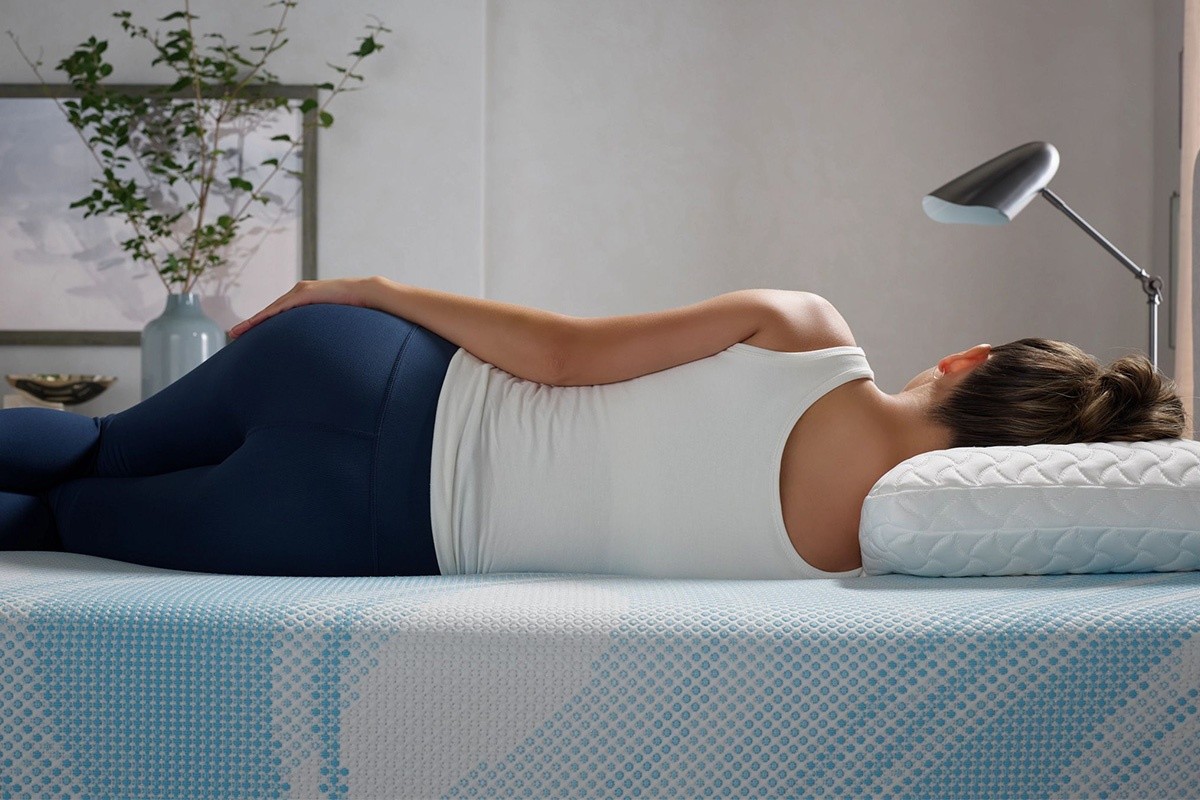
Many mattresses create support by compressing against the body. Springs, latex, and conventional foams can generate upward resistance that may lead to pressure buildup or subtle misalignment over the course of the night, making it harder for muscles to fully relax.
TEMPUR-Material® is engineered to respond differently. Instead of pressing upward against the body, it adapts and conforms to your unique shape. As it absorbs weight and pressure, it creates personalized support that helps stabilize the body without added resistance.
The result is support that feels more seamless and less intrusive — with comfort that allows the body to settle more fully into rest.
Key Differentiator: TEMPUR-Material® absorbs and adapts to pressure rather than resisting it — creating a 'with the body' support experience that differs from traditional spring or latex systems.
When a mattress doesn't support the body evenly, the spine can fall out of alignment. Hips may sink too deeply, shoulders can feel elevated, or the lower back may not feel fully supported.
An MRI-based study published in European Radiology Experimental measured lumbar spine angles in supine sleepers and confirmed that mattress surface type meaningfully affects lumbar lordosis angles and sacral slope compared to a rigid surface — demonstrating that mattress choice has a measurable impact on spinal geometry during sleep.2
Because TEMPUR-Material® adapts to your unique shape and weight distribution, it helps support the spine more evenly throughout the night. Whether you sleep on your back, side, or stomach, the mattress responds to heavier and lighter areas — helping the spine remain aligned without conscious effort.
For many sleepers, that balanced support can help reduce overnight discomfort and contribute to a more comfortable sleep experience.
Back discomfort isn't always isolated to one area. Pressure around the shoulders, hips, and lower back can create tension that keeps the body from fully unwinding throughout the night.
Research from The Hong Kong Polytechnic University found that mattress stiffness directly affects intervertebral disc stress and spinal curvature — with medium-firmness mattresses producing the most balanced spinal loading profile.3
TEMPUR-Material® redistributes weight more evenly across the mattress surface, helping reduce pressure points and encourage full-body comfort. When the body feels supported, it can be easier for muscles to relax and for sleep to come more naturally.
That sense of relief may feel subtle, but it can make a meaningful difference in how rested you feel by morning.
When sleep is interrupted by movement, pressure, or repeated repositioning, it can be harder for the body to settle into deeper, restorative rest — which is precisely when the body does its most critical repair work.
TEMPUR-Material® is known for absorbing motion rather than transferring it across the mattress, helping create a more undisturbed sleep environment — especially for couples. Staying comfortable in one position for longer periods may also help support a more consistent sleep posture through the night.
For people dealing with back discomfort, fewer disruptions can be an important part of getting restorative rest.
We designs our mattresses with real sleep in mind — not just how a mattress feels in a showroom. From advanced pressure relief to a range of comfort levels and support profiles, each model is engineered to meet different sleep needs and preferences.
Because back pain is not one-size-fits-all, support shouldn't be either. That's why Tempur‑Pedic® offers a range of mattress feels, so sleepers can choose the comfort and support that best fit their body. Key considerations include:
A mattress cannot replace medical care or eliminate back pain entirely. But the right mattress can help reduce common sleep disruptions — including pressure buildup, uneven support, and discomfort that interfere with quality rest.
That's what TEMPUR-Material® is designed to do: adapt, support, and help the body rest more comfortably throughout the night. And when sleep feels more restorative, mornings can feel better too.
This article is for informational purposes only and is not a substitute for professional medical advice, diagnosis, or treatment. If you experience chronic back pain, consult a qualified healthcare provider.
Is a Tempur-Pedic mattress good for back pain?
Tempur-Pedic mattresses are designed to support spinal alignment and reduce pressure points through TEMPUR-Material®, which adapts to each sleeper's unique shape and weight. While no mattress eliminates back pain, many back pain sufferers report improved sleep comfort on Tempur-Pedic products.
What makes TEMPUR-Material® different from memory foam?
TEMPUR-Material® is a proprietary material developed by Tempur-Pedic that adapts to body shape, weight, and temperature — offering more personalized contouring than traditional memory foam. It was originally developed from NASA research.
Does mattress firmness matter for back pain?
Yes. Scientific research shows that mattress stiffness affects spinal curvature and intervertebral disc stress. A medium-firmness mattress generally produces the most balanced spinal support for most sleepers, though individual needs vary.
Can a mattress affect spinal alignment?
Yes. MRI studies have confirmed that mattress surface type measurably affects lumbar lordosis angles and sacral slope during sleep, demonstrating that mattress selection has a direct impact on overnight spinal geometry.
How do I choose a Tempur-Pedic mattress for back pain?
Consider your sleep position, body weight, preferred firmness, and specific pain areas. Tempur-Pedic offers multiple comfort levels across its mattress lineup. Consulting a sleep specialist or trying a mattress with a trial period is also recommended.
Sources
1 Caggiari, Gianfilippo; Petrucci, Filippo; Pescia, Stefano; et al. "Mattress Impact on Lifestyle and Back Pain: A 25-Year Orthopedic Literature Review Guideline." Journal of Orthopaedics and Traumatology, published July 10, 2026. DOI: 10.1186/s10195-026-00945-3. PMID: 42432412. https://pubmed.ncbi.nlm.nih.gov/42432412/ — This systematic review evaluated 47 studies published between 1999 and 2023 examining mattress characteristics, spinal alignment, sleep quality, and low back pain. The authors found the strongest evidence supporting medium-firm mattresses for improved pressure distribution, reduced morning stiffness, better sleep quality, and lower back pain intensity.
2 Vitale, Jacopo Antonino; Borghi, Stefano; Bassani, Tito; Messina, Carmelo; Sconfienza, Luca Maria; Galbusera, Fabio. "Effect of a Mattress on Lumbar Spine Alignment in Supine Position in Healthy Subjects: An MRI Study." European Radiology Experimental, vol. 7, article 47, September 4, 2023. DOI: 10.1186/s41747-023-00361-w. PMCID: PMC10475448. PMID: 37661237. https://pmc.ncbi.nlm.nih.gov/articles/PMC10475448/ — This peer-reviewed MRI study compared spinal alignment on a medium-firm mattress versus a rigid surface in healthy adults. Researchers found that mattress use produced small but statistically significant changes in lumbar alignment, supporting the role of mattress design in spinal posture during sleep.
3 Hong, Tommy Tung-Ho; Wang, Yan; Wong, Duo Wai-Chi; Zhang, Guoxin; Tan, Qitao; Chen, Tony Lin-Wei; Zhang, Ming. "The Influence of Mattress Stiffness on Spinal Curvature and Intervertebral Disc Stress—An Experimental and Computational Study." Biology, vol. 11, no. 7, article 1030, July 8, 2022. DOI: 10.3390/biology11071030. https://www.mdpi.com/2079-7737/11/7/1030 — This experimental and biomechanical modeling study examined soft, medium, and firm mattresses and their effects on spinal curvature and intervertebral disc loading. Findings suggested that medium-firm mattresses provided more favorable spinal alignment and pressure distribution, while very soft or very firm mattresses were associated with less optimal biomechanical outcomes.
You’re using an unsupported web browser.
A list of the most popular browsers can be found below. Just click on an icon to visit the download page.
Your phone or tablet is using software unsupported by our website. To improve your shopping experience, please update your device to the latest version of iOS or Android OS.


