
Explore the stories, technologies and achievements that make Tempur-Pedic® the most highly recommended mattress brand in America*.
Explore the stories, technologies and achievements that make Tempur-Pedic® the most highly recommended mattress brand in America*.
— by Tempur-Pedic on Oct 23, 2026
There’s a common misconception in mattress shopping that if a bed feels soft, then it must lack support. This often leads to sleepers choosing mattresses that are too firm for their body shapes or preferred sleep positions. For sleepers who love the plush, cloud-like feel of soft mattresses, comfort doesn’t always have to come at the expense of alignment.
You may be surprised to learn that softness and support aren’t always opposites; they should work together when the mattress is designed correctly. Research on mattress biomechanics has found that spinal support is influenced not only by mattress firmness but also by how effectively a sleep surface distributes pressure and maintains natural spinal curvature (Biology, vol. 11, no. 1030, July 8, 2022).
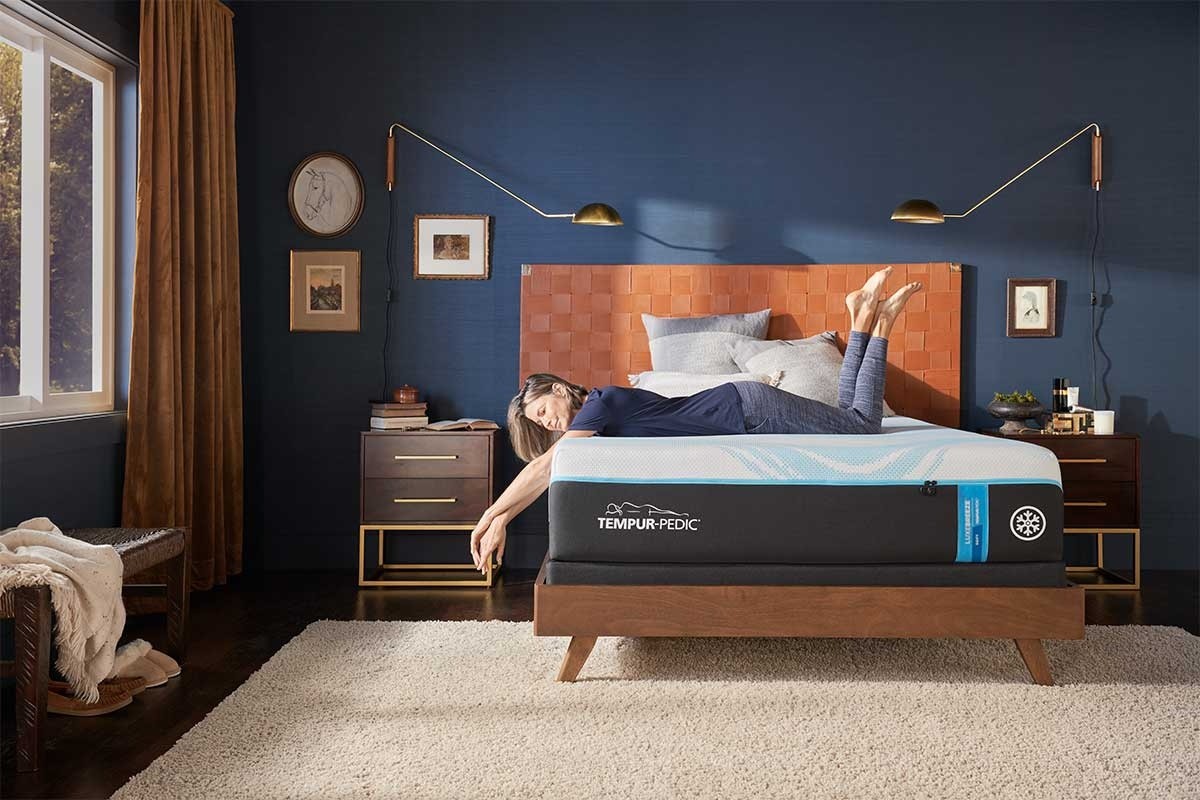
“Soft” is often confused with “unsupportive,” but they are not the same thing. A supportive mattress isn’t defined by “firmness,” rather by how well it maintains proper spinal alignment of your body throughout the night.
A soft Tempur‑Pedic® mattress feels more yielding on the surface, yet it’s engineered to adapt intelligently to your body. Instead of pushing back evenly like a traditional innerspring or collapsing like low-density foam, TEMPUR‑Material® is designed to respond precisely to pressure, weight, and shape.
The result? A sleep surface that feels like it melts while still supporting your body where you need it most. According to researchers studying mattress stiffness and spinal curvature, support is optimized when the sleep surface allows the body to sink enough to reduce pressure concentrations while still maintaining healthy spinal positioning (Biology, vol. 11, no. 1030, July 8, 2022).
Proper spinal alignment means your body stays in a natural position whether you sleep on your side or back. A soft Tempur‑Pedic® mattress can help by:
Recent research published in Mechanics of Advanced Materials and Structures (2025) found that a mattress's materials can play an important role in both pressure relief and spinal alignment, suggesting that proper support is determined by more than firmness alone.
When your body is evenly supported, muscles don’t have to stay engaged to compensate for poor positioning. That often means less tension, fewer pressure‑related wakeups, and more restorative rest. Sleep ergonomics studies have shown that pressure distribution and spinal neutrality are among the most important variables associated with nighttime comfort and reduced body stress (Hong et al., 2022).
Pressure relief can be especially important at the shoulders, hips, and joints—areas that tend to bear the most weight. On a soft Tempur‑Pedic® mattress, these pressure points are gently cushioned as the TEMPUR‑Material® conforms closely to your body’s unique shape. This deep conformance helps:
By contouring to the body's natural curves, a mattress may relieve pressure around the shoulders, hips, and lower back, areas that often experience the greatest stress during sleep (Biology, vol. 11, no. 1030, 2022).
A mattress doesn’t have to feel firm to the touch to be supportive.
Thanks to TEMPUR‑Material®’s adaptability, softness doesn’t necessarily mean instability; it means responsive comfort designed to work with your body. The goal when selecting a mattress should not be maximum firmness, but an optimal balance between pressure relief and spinal alignment, allowing sleepers to experience comfort without sacrificing support (Hong et al., Biology, 2022; Khatir et al., “Mechanics of Advanced Materials and Structures,” 2025).
A Note from Tempur-Pedic: This content is for informational or general educational purposes only and does not constitute individualized advice. It is not intended to replace professional medical evaluation, diagnosis, or treatment. Always seek the advice of your physician for questions you may have regarding your sleep quality and overall health.
Yes. Support and firmness are different characteristics. A mattress can feel soft on the surface while still maintaining spinal alignment if its materials respond appropriately to body weight and pressure.
Many side sleepers prefer softer comfort layers because they can cushion pressure-sensitive areas such as the shoulders and hips. The key is ensuring that deeper support layers continue to keep the spine aligned.
Pressure relief can reduce discomfort and minimize position changes during the night. When pressure points are cushioned effectively, sleepers may experience fewer interruptions and greater overall comfort.
Pressure relief refers to how well a mattress distributes body weight and reduces stress on joints and pressure points. Support refers to how well the mattress keeps the spine and body in a neutral, aligned position.
TEMPUR-Material® conforms closely to the body, increasing contact area and distributing weight more evenly. This can create a soft feel while still preventing excessive sagging and helping maintain alignment.
Hong, Tommy Tung‑Ho; Wang, Yan; Wong, Duo Wai‑Chi; Zhang, Guoxin; Tan, Qitao; Chen, Tony Lin‑Wei; Zhang, Ming. “The Influence of Mattress Stiffness on Spinal Curvature and Intervertebral Disc Stress—An Experimental and Computational Study.” Biology, vol. 11, no. 1030, July 8, 2022. Published by MDPI. DOI: 10.3390/biology11071030. PMC ID: PMC9311775. View Study. Full URL: https://pmc.ncbi.nlm.nih.gov/articles/PMC9311775 This peer-reviewed study evaluated soft, medium, and hard mattress systems and measured their effects on spinal curvature and intervertebral disc loading. Researchers found that different support surfaces altered spinal positioning and pressure distribution, concluding that mattress design plays a crucial role in balancing comfort and spinal support.
Khatir, Omar; Abdelkader, Benkhettou; Ismail, Boudjemaa; Sahli, Abderahman; Bouiadjra, Bel Abbes Bachir; Hamada, Atef; Benbarek, Smail. “Impact of Mattress Foam Hyperelasticity on Interface Pressure and Spinal Alignment: A Finite Element Analysis Study.” Mechanics of Advanced Materials and Structures, 2025. Published by Taylor & Francis. DOI: 10.1080/15376494.2025.2464254. View study. Full URL: https://www.tandfonline.com/doi/full/10.1080/15376494.2025.2464254 This peer-reviewed biomechanical analysis examined how foam properties influence pressure distribution and spinal alignment. The study demonstrated that material responsiveness directly affects support performance, showing that alignment and pressure relief can be achieved simultaneously through appropriate mattress design.
You’re using an unsupported web browser.
A list of the most popular browsers can be found below. Just click on an icon to visit the download page.
Your phone or tablet is using software unsupported by our website. To improve your shopping experience, please update your device to the latest version of iOS or Android OS.


